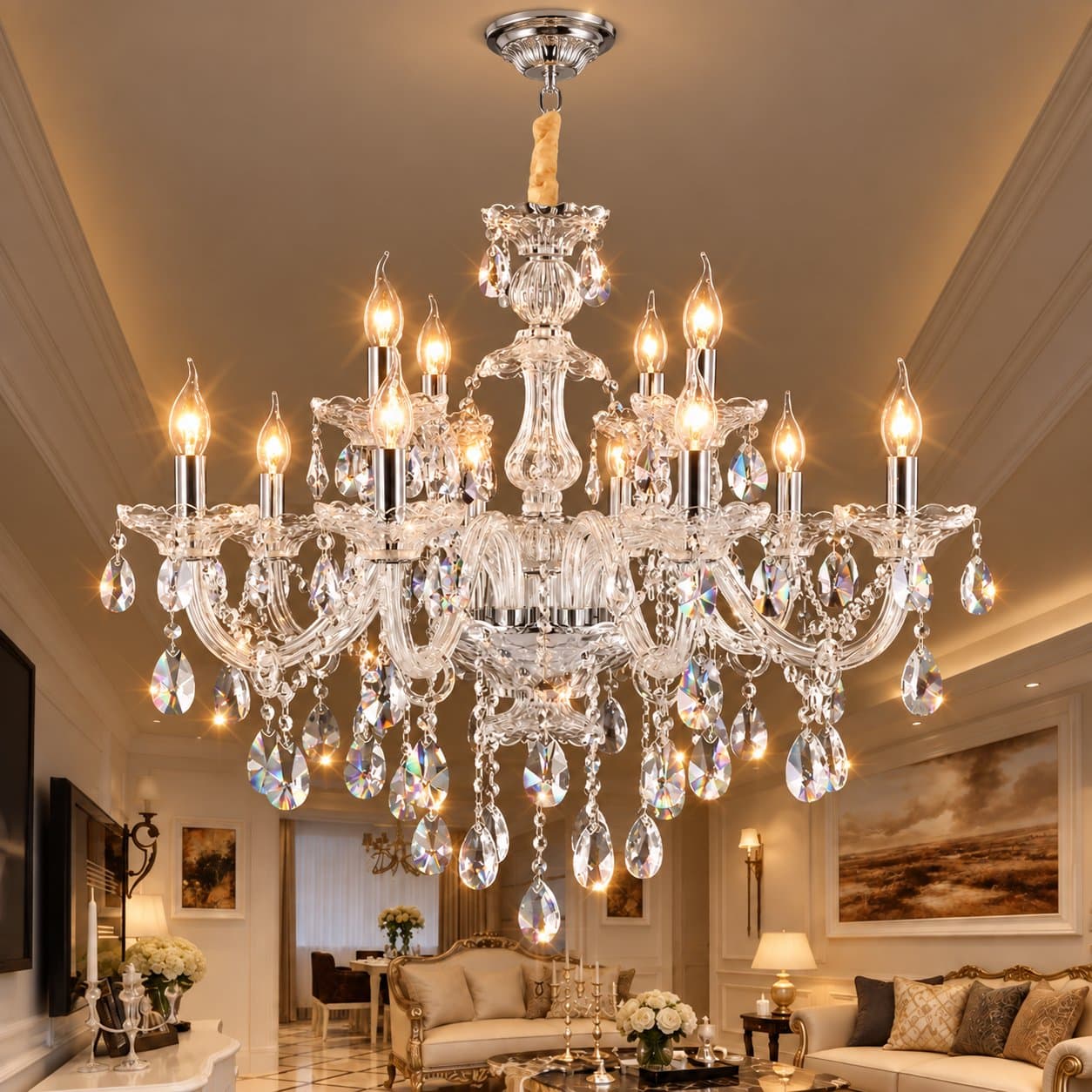

Looking at two chandeliers and wondering why one is called a crystal chandelier while the other is a glass chandelier? They may look almost the same at first, but the materials can be quite different. Understanding the crystal vs glass chandelier difference can help you know what you are paying for before you buy.
So, what is the difference between glass and crystal? Which one sparkles more, which one feels heavier, and does a higher price always mean you are getting real crystal? Understanding the material, cut, clarity, weight and way it interacts with light can help you make a more informed purchase. This guide explains the difference between crystal and glass, the main types of chandeliers you may encounter, how to tell the difference between materials, and what to consider when choosing a chandelier for your home.
What Is the Difference Between Glass and Crystal?
The easiest way to understand the difference between glass and crystal is to look at their composition and optical behavior. Both materials can be transparent, decorative and suitable for lighting. However, their mineral composition can affect density, clarity, weight and how they interact with light.
A traditional lead crystal is a form of glass containing lead oxide. The lead content increases the density of the material and can influence how light travels through it. This is one reason some traditional crystal pieces feel heavier than glass and produce stronger optical effects. When light passes through a well-cut crystal piece, its surfaces can bend and redirect the light. This process, known as refraction, can create flashes of color, a rainbow effect and a noticeable sparkle.
Glass can also be clear, polished and attractive. A quality glass chandelier may produce beautiful reflections and a clean appearance, but the effect is often softer than that of highly refractive crystal. That is the basic difference between crystal and ordinary glass, but there is more to consider before deciding which material is right for your home.
How Do Crystal and Glass Chandeliers Actually Behave Differently?
When comparing crystal and glass chandeliers, do not judge them only by how they look in a showroom.
Showroom lighting is designed to make decorative lighting look impressive. Almost any polished surface can shine under strong artificial lights. What matters is how the material behaves when it is exposed to ordinary lighting in your home. A well-made crystal chandelier can produce a more noticeable sparkle because its facets redirect light in several directions. If sunlight or a strong bulb hits a prismatic piece at the right angle, it may create coloured reflections across a wall or ceiling.
A glass chandelier can produce a beautiful reflection too, but its appearance is usually more understated. This can actually be desirable in a room where you want elegant lighting without too much visual drama. The choice therefore comes down to more than material. Your interior style, room size, lighting needs, budget and personal preference all matter.
What Makes a Crystal Chandelier Sparkle?
The sparkle associated with crystals is not simply because the material is “shiny.” The cut plays a major role. A crystal piece can be shaped with multiple surfaces called facets. Each facet changes the direction in which light travels through the material. When several facets work together, the result can be a lively combination of reflection and refraction.
Think of a small prism. When light enters it, the light can bend and separate into different colors. Crystal used in decorative lighting can create a similar visual effect, although the exact result depends on the material, cut, clarity and light source. This is why cut crystal is valued in decorative lighting. Sharp, carefully formed facets can produce more noticeable flashes than pieces with simple rounded edges.
By comparison, a smooth piece with rounded edges may reflect light without creating the same level of prismatic effect. So when you look at a chandelier, do not only ask, “Does it sparkle?” Look at how it sparkles.
What Is Lead Crystal, and What Does Lead Content Mean?
Traditional lead crystals contain a significant amount of lead oxide. The lead content changes the density and optical characteristics of the material. The term “leaded crystal” is sometimes used to describe this type of crystal. Historically, higher lead content has been associated with greater density, clarity and refractive properties.
However, the presence of lead does not automatically make one chandelier suitable for every buyer. Today, there are also lead-free crystal options made using other mineral compositions. K9 optical crystal is one example commonly used in decorative products.
This distinction is useful when shopping because the word “crystal” alone does not tell you exactly what material has been used. If a supplier describes a product as crystal, ask for the material specification. Is it lead crystal? K9? Another lead-free crystal? Crystal glass? Or ordinary glass? Knowing the specification helps you understand what you are actually paying for.
Is K9 Crystal the Same as Traditional Crystal?
K9 is one of the most commonly encountered terms when shopping for decorative crystal lighting. K9 optical crystal is a genuine optical material and should not automatically be described as fake simply because it is not lead crystal. It is a lead-free crystal material with good clarity and optical properties, which makes it suitable for decorative lighting and chandelier components. This is particularly important for buyers who have been told that anything without lead oxide is not “real” crystal. That is too simplistic.
Different crystal materials exist for different purposes. A modern crystal product may use a lead-free composition while still offering attractive clarity and light refraction. The better question is not whether K9 is “real enough.” The better question is whether the supplier has clearly stated the material and whether its characteristics match what you want.